
Amaterasu Omikami, The Sun Goddess Comes to Colorado by Valerie Lorig
 Barbara Foley Bott
by Valerie Lorig
Amaterasu-Omikami’s shrine resides on a mountain above the Great Stupa at Drala Mountain Center. Known as the Sun Goddess, Amaterasu means brilliant rays of light that shine in all directions. Omikami is a divine being that evokes a sense of wonder and awe in the human heart. Mountains, lakes, trees, rocks, or even people can have the quality of kami, similar to the idea of drala in the Tibetan tradition.
In 1983, Trungpa Rinpoche went to Japan with a group of eighty students, where he visited the inner sanctums of the sacred Japanese Shinto site, Ise Kotaijingu, the main shrine of Amaterasu-Omikami. One of the very few people allowed to enter the inner courtyard besides emperors or Shinto priests, Rinpoche connected with her. He asked Amaterasu to come home with him, but apparently this request inspired a fight. The two of them engaged in an energetic battle over his insistence that she accompany him back to Colorado. Eventually she agreed and he said he carried an emanation of her home in his pocket.
Rinpoche’s heart friend, the twentieth generation bow maker to the emperor of Japan, Kanjuro Shibata Sensei, had a modest Kami shrine built for her in 1992 at Rocky Mountain Dharma Center, now called Drala Mountain. In traditional Japanese Shinto style, a dwelling now enshrines the emanation of Amaterasu. That summer several Japanese Shinto priests came from Tsubaki Grand Shrine in California to perform the consecration. Her shrine at Drala Mountain is a small, rustic wooden house that sits high up in a pine forest. In order to approach her it is customary to purify oneself with water and offer a series of bows and claps that make one’s presence known.
Amaterasu’s Origin Story
Rinpoche said Amaterasu appeared from the cosmic mirror; the original mirror of existence that has no beginning and no end. The cosmic mirror accommodates both co-emergent wisdom and co-emergent ignorance. Everything arises from it; saints and sinners, beauty and horror, creation and destruction. According to Rinpoche, the Great Eastern Sun is a metaphor for the feminine principle. The Great Eastern Sun is the quality of self-existing light like our physical sun, which illuminates the darkness of confusion, pettiness, and cowardice. Possessing the warmth and genuine care of the mother principle, the Great Eastern Sun is the vision that moves people forward. Rinpoche asserted that “Without the feminine principle, there is no enlightened warriorship.”
In Japanese culture Amaterasu was the creator of the world, however when she hid herself in darkness she could also destroy the world. It is said she created the lands of Japan, shaping Japanese history for over 1500 years. As the Goddess of the Sun, she ruled the heavens. Susanoo, Amaterasu’s younger brother, was the unpredictable deity of storms and thunder. Disrespecting Amaterasu, he showed off his powers with strong winds that destroyed her beloved gardens. Both enraged and terrified, she shrouded herself in a cave behind a heavy rock door and the whole world became completely dark and cold. With Amaterasu hidden, weeks passed without sun and people became sick and depressed. Desperate, hundreds of kami devised a plan to lure Amaterasu out of her cave by creating a celebration around her with music, dance, and loud merry-making. The assembled kami devised a trick, insinuating that another deity more impressive than Amaterasu herself had appeared at the party. Concerned, curiosity propelled her to steal a glance from her hiding place to get a better look. A mirror held by the kami, who were gathered outside the cave, revealed her own radiant image. Little did she know that the light she saw was none other than her own reflection of power and beauty. When the first stream of the Amaterasu’s light shone, the kami used their full strength to pull the rock door open and she had no choice but to come out. Hiding in fear and denying her light to the world was not her true nature. The Sun Goddess shined again and life was restored.
Amaterasu’s story points out her reluctance to manifest fully, discouraged by her brother’s overpowering disregard for her. When she witnessed her own reflection, it was a sign she could be recognized and experienced properly. Then she was willing to reveal her magnificence having seen her strength and splendor in the mirror. Trungpa Rinpoche implored his students to look in the mirror – not to shy away from their brilliance – and let their light shine with confidence.
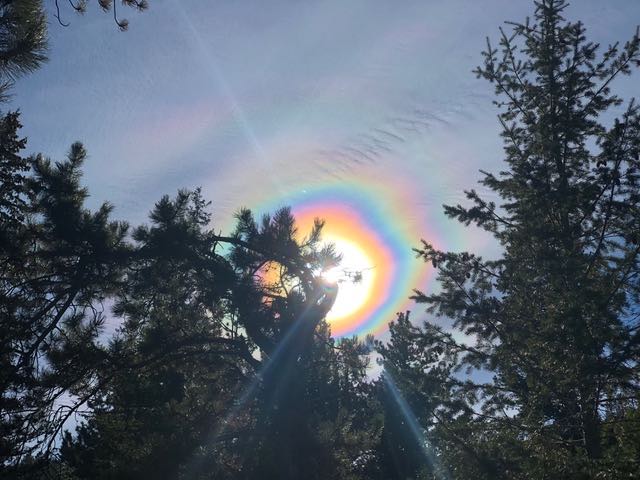
Years later, one sparkling autumn morning, I took a group of Naropa University psychology students to the Amaterasu’s Kami Shrine during a retreat. Everyone participated in the purifying, bowing, and clapping rituals. Then we performed the Invocation to the Four Directions ritual in her outer courtyard as an offering. Afterwards students found places on the pine forest hillside to meditate in the open space of Amaterasu’s presence. One never knows how Amaterasu will manifest. Some stories say she can be intense or fickle with a jealous streak. She must have liked these students because as we turned around to leave she revealed her radiance in the most stunning sun rainbow I have ever seen. Her presence was so exquisite that all of us stood speechless in awe of her luminous beauty.
When you visit Drala Mountain Center consider paying your respects to Amaterasu, and connect with the seat of feminine magic on the land. You never know how she might greet you.
© Valerie Lorig, (2025)
Photo of Amaterasu’s Sun Rainbow taken by Naropa University student, Barbara Foley Bott
1) Drala in Tibetan means above the enemy or above aggression. It can also be a name for a local spirit or energy.
2) Trungpa, Collected Kalapa Assemblies, 2006
3) https://mythologysource.com/amaterasu-japanese-goddess/
4) Trungpa, Collected Kalapa Assemblies
5) The Invocation of the Four Directions, written by Trungpa Rinpoche, is a Shambhala ritual that invokes the energy of the Four Dignities. By chanting and using milky water as a purification substance, the Meekness of the Tiger, the Perkiness of the Snow Lion, the Outrageousness of the Garuda, and the Inscrutability of the Dragon are evoked.